
Sunday, January 14, 2007

Researching the Origins of Black St. Louis

I am seeking any information about the history of African Americans in Saint Louis, Missouri during the colonial and antebellum period, and through the civil rights era. I would particularly like to know more about the arrival of the French speaking Africans that came from Haiti by way of Canada, the Mill Creek neighborhood and Gaslight Square, and civil rights activities. I’ve already collected a few websites and articles, but if you know of or have any information about any others, or books or places of interest, please email info to me at boldness-genius@hotmail.com.
Labels:

Sunday, October 01, 2006

My Favorite St. Louis Website!


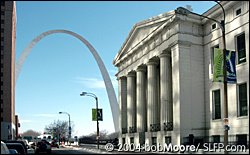
Built St. Louis , a website created and maintained by Rob Powers, is the place I began my journey back home. Its detailed, documented pieces (with pictures) brought back so many memories about growing up in the Gateway City, yes including trips to the top of the Arch, and breezy club nights on Laclede's Landing at Mike Talayna's and The Brass Rail. There are also links to some more very interesting sites about St. Louis. The site covers the demolition of architectural landmarks, the city's ever changing landscapes, and the unique composition of St. Louis neighborhoods. This site beautifully documents St. Louis' past and present from the POV of its architecture and cityscapes, and preserves it forever unlike any other source I've seen.

Labels:

Saturday, September 30, 2006

How Many Ways to Go Back Home


When I left Saint Louis many years ago I left believing I had no reason to ever return, except perhaps for the occasional visit such as the one I made just this past Labor Day. With both my parents having been long deceased and childhood memories that are ordinary, embarrassing, occasionally haunting and questionable, I’ve never believed I left anything that would make me want to go back to live there. In fact, now that I have firmly established myself in the Atlanta Metro area, married and all, I was even beginning to fancy myself a Southern writer, particularly since I have one manuscript set very distinctly in Atlanta. But, recently it seems as though my heart is beginning to soften when I think of the place that I no longer call home, but that I know is inherently a part of me; it is in my soul and has made me the person that I am. It took me a long time to accept this. People from the south have such a distinct personality and culture, as do those from the west and up north. Midwesterners, in my opinion, are a little generic, bland; no well-defined mannerisms, or accents or traditions. I wanted to be connected somehow to the rich civil rights history of the south, to be a Georgia peach. I even began to bask in the glow of people commenting on my supposed country accent.

Last spring break, I took a day-trip to Monticello, Georgia for some back roads photo opps and maybe some stories about ‘how bad it used to be’. I met three people there who all seemed like they belonged somewhere else. One lady was the first black president of the Monticello Chamber of Commerce, one worked for the chamber of commerce but had been an extra in several movies, and one was a man who ran a family-owned restaurant. All of them had lived in various places: Atlanta, California, Houston… When I asked how they ended up back in such a god-forsaken place, every one of them came back because of an ill or elderly parent. Again my parents are deceased, but from that moment on I decided to stop saying and believing that I would never go back. My Aunt, who lived for many, many years (over 40) in Detroit, went back home to Saint Louis at the age of seventy, after the death of her husband. This is a woman who has traveled all over the place, and if she was drawn to return, who am I?

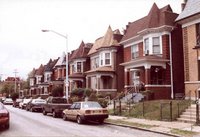
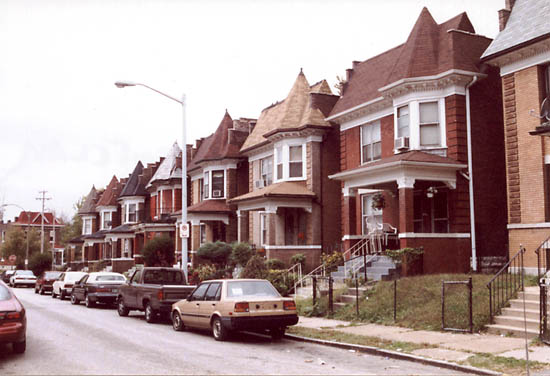
The one thing, without a doubt, that has kept me connected to the place I was born, (besides the fact that I still have two sisters there), is its architecture. From the two-storied, red brick flats of Hyde Park, the granite and marble of its municipal buildings, or the distinct style of the public schools designed and built by William B. Ittner and Rockwell M. Milligan between 1897 and 1925, I feel inescapably linked to this city through its history and my own.

And now through my study of American History and Literature, I am discovering new ways in which I am further rapt by this city named for King Louis IX of France (1215-1270), and purchased from the French in 1803, by President Thomas Jefferson as part of the Louisiana Purchase. Those names that I was introduced to by street signs and suburb markers come to life in stories about colonial Saint Louis: Choteau, Laclede, Bellerive, Lewis and Clark. Now, the stories of Africans who were part of that colonial history haunt me; Dred Scott, Jeannette Forchet, William Wells Brown. And, then there are those that came later like, Madame C.J. Walker, Cool Papa Bell, and Redd Foxx. And, of course there is a rich literary history established by T. S. Elliot, William Wells Brown, Kate Chopin, Tennessee Williams, and Sara Teasdale.

Now, characters from Saint Louis in the 1790s, 1930s, 1950s, ’65 are beginning to possess me with stories of Gaslight Square, Laclede Village, Mill Creek and the dairy farms of Harney Heights in the 1800s. My Uncle, who has transcended this life, and in fact has rooted himself firmly as one of my muses, I believe, is heading this influx of spirit and energy. In an email just before his death, when I was ranting about how abeyant, fragmented and ordinary St. Louis and St. Louisans were, he gently reminded me that I “was of Saint Louis stock, born and bred. So, don't knock it”.


"The City of St. Louis has affected me more deeply than any other
environment has ever done, I consider myself fortunate to have been born here, rather than in Boston, or New York, or London."

— T.S. Elliot on St. Louis

Labels: ,

Tuesday, September 12, 2006

Shooting Hooky and Aspirations of Becoming A Writer


The three moments I remember as being a realization that I was on to something with this writing thing were the time I overheard my mother on the telephone bragging to one of her friends that I’d written a ‘book’. I was in the eight grade at the time, and she found out about it because I’d gotten into trouble for working on my ‘book’ (a story about a fashion designer named Casey Wycliff) during class time. And, in my junior year in high school, I entered a national scholastic writing competition and won fourth place for a one-act play about a teen-aged boy molested by his mother. I also got a fifteen dollar check from NBC for my efforts. Then there was the time my sophomore English teacher asked me to write an essay at the beginning of class. By the end of class I’d finished it, and unbeknownst to me, he entered it in a district wide composition competition, and I won third place. My essay was about what I did when I occasionally played hooky from school. Now, call me what you will (nerd, geek), but when I played hooky I’d go to Forest Park in St. Louis with the guy I called my boyfriend and…no, not climb in the backseat of a car. We’d go to the Municipal Opera (MUNY) during the off season, sneak in under a padlocked fence and see how it felt to be on the stage of an amphitheater. I’d fantasize about receiving a fifteen minute standing ovation for the opening and closing of my award winning play. But, there was another favorite hooky spot that I relished even more. Don’t laugh. It was the St. Louis Public Library.

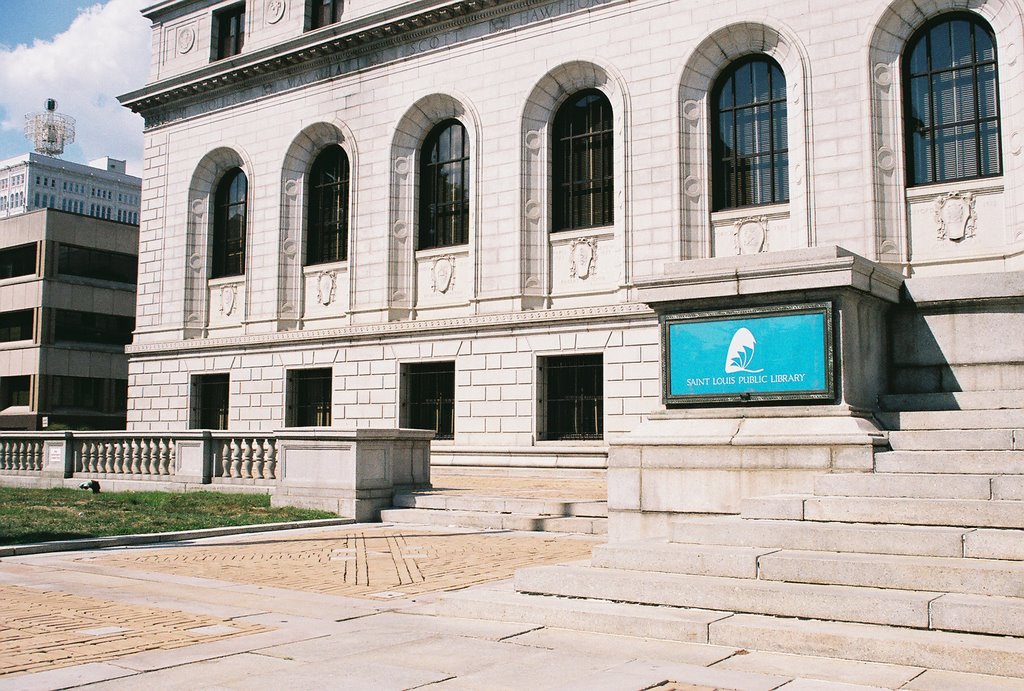
Ah yes, I have fond memories of walking up the grand marble staircase from Olive Street which was used in the past as a reviewing area for parades passing through downtown. And, of scaling the Maine granite and marble panels with relief carvings of early printers' marks, decorative medallions, notable authors and inspirational inscriptions as I approached its doors. Traipsing its marbled floors modeled on the floor of the Pantheon in Rome; inhaling the aroma of the aged oak tables, marble, dust and old books is a scent that is eternal, and I will always treasure it. I recently learned that in 1901, philanthropist Andrew Carnegie offered the city $1 million for construction of this central library. And, that architect Cass Gilbert, who was the architect for the Saint Louis Art Museum, the U. S. Supreme Court Building in Washington, D.C. and the Woolworth Building in New York City, was selected to design the building. It opened in 1912.
Perhaps it is that geek in me that compelled me, while on a mini-vacation over Labor Day to visit my peeps, to drag my beloved to the place where I fell in love with books. He sat so patiently in the car while I got out, much to the intrigue of the downtown vagrants, and photographed this building that all of these years later still enthrall me.

Labels: , ,

Thursday, August 24, 2006

Defense for Andrew Young

I don’t know about you, but, I grew up in a neighborhood that, although it was not as bad as it has become since I’ve moved away, it still was not nearly as rosy as Wisteria Lane. Before we were “urban contemporary”, we were “the Northside” or “Southside”.

“Where you from?”
“Penrose.”
“Walnut Park.”
“Westside.”
“Pruit-Igoe.”
“Bluemyer”
“Eastside.”

For the most part, these neighborhoods were beginning to integrate in the early to mid-sixties and most if not all of the neighborhood stores (we used to call them Confectionaries) were owned by someone, or someone’s parents who had freely immigrated from somewhere else. In my neighborhood there was Finnigers, whose owners were not surprisingly German, being that my area, Walnut Park, was a popular residential destination for Germans in the late 1800s. And, there was Union Market, whose proprietors were Jewish. As a child, I didn’t think very much about who the owners were. In the early sixties it was not uncommon to see Caucasians minding a store or running a business. Not since those days have I heard anybody’s mother tell them,

“Baby, run up to de corner store and get Mama a halfa stick ‘o butter for my pie.”

Or

“Mr. Finniger, can I get fifty cent wortha boloney.”

Or, hogshead cheese, and a stale box of vanilla wafers, ten cent sodas, or the classic,

“Go get Uncle Petey five cigarettes from Union Market. Make that three. And, a coupla matches.”

And, it was only as I began to grow older, more perceptive and often having traveled or socialized to some of those previously mentioned neighborhoods that I, my friends and family would sometimes jokingly testify about regularly observing rodents in some of these fine establishments. It was a known fact, and perhaps sadly accepted, that in some of these local grocers that bread, out of date long before we learned what those colorful little twist ties were for, sat for weeks on the shelves until…well Hell, until somebody who didn’t have a car to go way across town to a supermarket, bought it.

Even now, as an adult, I am conscious when I step into neighborhood convenience stores or gas stations or beauty supply shops or Dunkin Donuts. It’s not just me. I know eyes follow my every move. I have been followed through isles. I have had change casually tossed on the counter to me. I have been overcharged. I have been ignored. I have been treated with disdain. I wouldn’t dare buy vegetables or bread. I don’t eat meat, but if I did, humph.

African-Americans are the poster children for racism. We can sniff it out like a bomb search dog. Racism is not the same thing as recognizing that the men who hijacked the airplanes on September 11th were of Arab descent. Racism is using that information to suggest that all Arabs are terrorists, and as a result, restrict the movements of every Arab, or detain as many Arabs as you can, or hate all Arabs and not let them learn to read, or go to school, or get a job, or live in your neighborhoods and eat at your lunch counters. The mistake Andrew Young made was that he was Andrew Young; civil rights icon, former Atlanta mayor, former U.S. Ambassador. Had he been Percy Washington in Chicago, no one would’ve blinked an eye. Did Andrew Young say he didn’t like Jews, Koreans or Arabs because of the color of their skin? Did he say something, or make an accusation that at some time or another was not true? And, while we understand that not all people from other places who find themselves earning a living in our neighborhoods are bad people, the truth is that we’ve all been in that grocery store with the stale bread and the wilted vegetables. That ain’t racism. That’s just the truth.

Labels: , ,